Automotive manufacturing
Ordering the vehicle mix a factory can actually build
A demand model and a mixed-integer optimizer that turned predicted buyer preferences into a buildable three-month vehicle order under component, plant, and policy constraints.
$64M
Incremental profit, project-reported
3 mo.
Order horizon covered by each recommendation
Client
Global automotive manufacturer
Basis
Partner experience, prior role
The insight
“Predicting desirable vehicles is only half the problem. Independent rankings are not a production plan: highly ranked configurations compete for the same scarce components.”
Exhibit
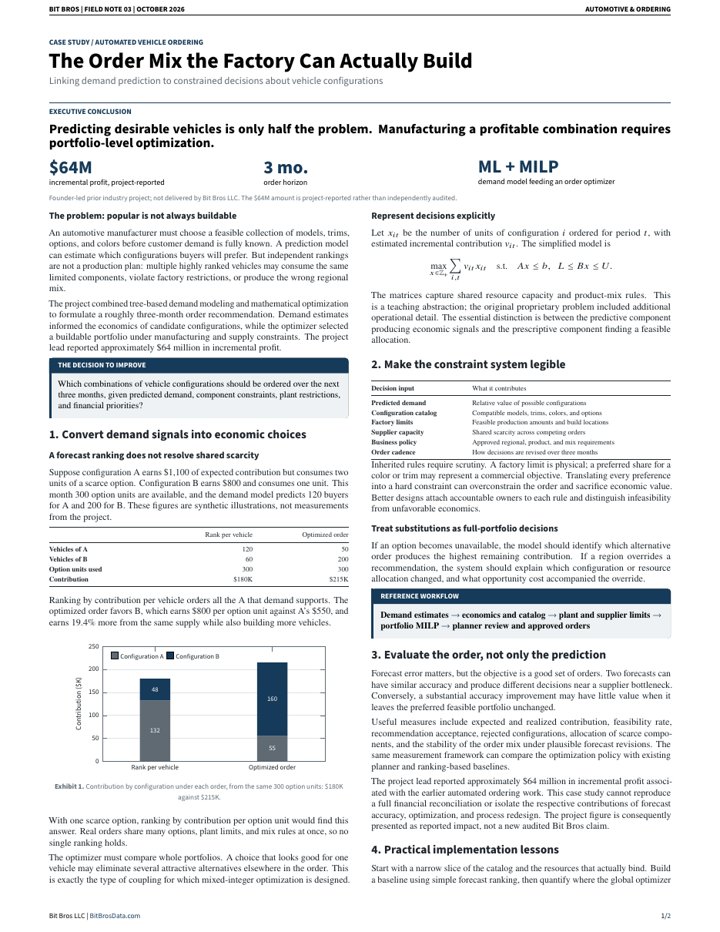
The same scarce option, 19.4% more contribution
Contribution by configuration from 300 option units
Illustrative, from Field Note 03: A earns $1,100 and uses 2 option units; B earns $800 and uses 1; predicted demand is 120 and 200. B earns more per option unit, so the optimized order builds all the B demand supports.
Choosing a buildable order before demand is known
An automotive manufacturer must commit to a collection of models, trims, options, and colors before customer demand is fully known. The work produced a roughly three-month order recommendation, combining a tree-based demand model with mathematical optimization.
Popular is not always buildable
A prediction model can estimate which configurations buyers will prefer, but a ranked list is not a production plan. Several highly ranked vehicles may draw on the same limited component, violate a factory restriction, or produce the wrong regional mix. A choice that looks good for one vehicle can rule out several attractive alternatives elsewhere in the order.
An optimizer that orders the whole portfolio
Demand estimates set the economics of each candidate configuration, and a mixed-integer program selected the order with the highest total contribution under configuration compatibility, plant limits, supplier capacity, and approved product and regional mix rules.
The lessons that transfer concern the system around the optimizer. Physical limits should stay hard while commercial preferences become trade-offs with accountable owners, and every substitution or planner override should carry a visible opportunity cost.
$64M in reported incremental profit
The project lead reported about $64 million in incremental profit from the automated ordering work. The figure is project-reported, not independently audited, and the respective contributions of forecast accuracy, optimization, and process redesign were not separated.
Field Note 03 / 2-page PDF
The Order Mix the Factory Can Actually Build
The full write-up: why popular is not always buildable, a worked two-configuration example, the constraint system, how to evaluate an order, implementation lessons, and what a modern version would add.
What made the difference
01
Turn predictions into economics
A tree-based demand model estimated buyer preference for each configuration, and those estimates became the expected contribution of every candidate order.
02
Make the constraints legible
Configuration compatibility, plant limits, supplier capacity, and approved mix rules were modeled as shared constraints, so the optimizer compared whole orders rather than individual vehicles.
03
Judge the order, not the forecast
An order is worth what it earns under the same limits. Forecast accuracy matters only through its effect on the order the optimizer chooses.