Automotive manufacturing
Deciding vehicle content and pricing with choice models and Monte Carlo optimization
Statistical choice models, Monte Carlo simulation and optimization that decide which features each trim carries as standard, optional or not offered, and at what prices.
2 min read Partner experience, prior role
Client
Global automotive manufacturer
Services
Basis
Partner experience, prior role
The insight
“Every feature is a pricing decision. Re-pricing a vehicle line moves profit a little; re-contenting it, so buyers stop paying for features they do not value, moves it a lot.”
Exhibit
Re-contenting earns 17% more and wins share
Expected profit against market share for content-and-price plans
Illustrative, from Field Note 12: a synthetic three-trim, nine-feature line with mixed-logit buyers and a competitor. Each frontier point is a content-and-price plan found by optimization; the engineering-led baseline sits inside it.
Which features, on which trims, at what price
Long before a model year launches, an automaker must decide its content: which customer-facing features each trim carries as standard, which are offered as options, which are not offered at all, and at what prices. Engineering, sourcing and manufacturing then build around those choices for years.
A combinatorial pricing problem nobody can enumerate
Even a modest line of three trims and nine features has trillions of possible content plans, and buyers differ widely in what they value. A feature made standard everywhere forces some buyers to pay for something they do not want; a feature held back may send others to a competitor. Rules of thumb and cost-plus pricing cannot see those trade-offs.
Choice models, Monte Carlo and optimization together
This work, led by Adam DeJans Jr. and John Brandon Elam in earlier industry roles, combined statistics, probability, Monte Carlo simulation and optimization. Statistical choice models estimated how heterogeneous buyers trade features against price; Monte Carlo simulation carried the uncertainty in those estimates into the profit of each candidate plan; and optimization searched content assignments and prices together. The approach closely parallels the vehicle content optimization General Motors has published, which GM reports produced $4.4 billion in verified incremental profit across its programs; that figure is GM’s, not this work’s.
Plans that raise profit and customer value together
The method’s value comes from re-contenting rather than re-pricing: in the field note’s synthetic worked example, re-pricing a baseline line gains under 1%, while optimizing content and prices together gains 17% in expected profit and raises share and customer value. Financial outcomes for this work are not published.
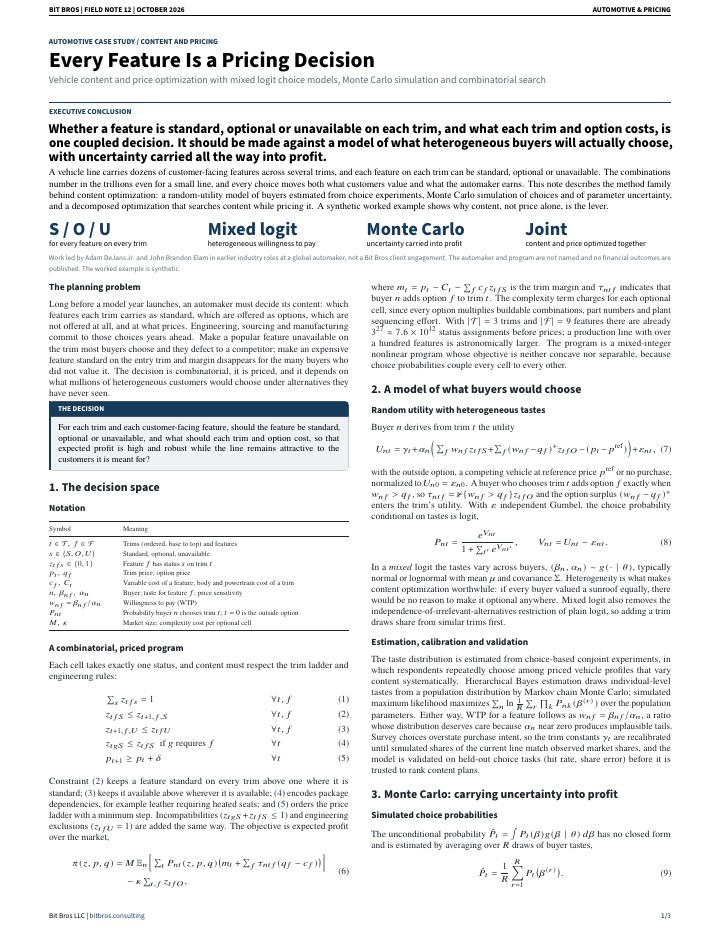
Field Note 12 / 3-page PDF
Every Feature Is a Pricing Decision
The full write-up: the content decision as a combinatorial pricing problem, mixed-logit models of heterogeneous buyers, Monte Carlo over preference and parameter uncertainty, content search with inner price optimization, and a synthetic worked example.
What made the difference
01
Model what buyers value
Statistical choice models estimated how much different buyers value each feature and how they trade features against price.
02
Carry the uncertainty
Monte Carlo simulation propagated the uncertainty in those estimates into the profit of every candidate plan, so plans were compared on risk as well as expectation.
03
Optimize content and price together
Optimization searched the enormous space of feature assignments by trim, with prices set for each candidate, to find plans that raise profit and customer value together.
Related insights
The Search Space Is a Business Decision
Why simulation optimization often succeeds or fails before the search algorithm starts, and how practitioners should design candidate decisions around operational reality.
ReadShow the Options, Not Just the Answer
Why decision systems should produce a recommendation, but also expose the tradeoffs, alternatives, and risk profiles behind it.
ReadFrom Distribution to Decision: How Probabilities Become Order Quantities
Probabilistic forecasts don't mean fuzzy answers. You still land on a single number — you just land on the right one.
Read